Temperature measurement is essential in many industrial processes. From chemical plants to power facilities, accurate temperature monitoring can help operators understand process conditions and maintain equipment performance.
Thermowells provide protection for temperature sensors installed in industrial environments. They are available in different configurations, materials and connection arrangements.
Understanding the types of thermowells can therefore help engineers and procurement teams identify a design suited to their particular application.
What Is a Thermowell?
A thermowell is a protective tube installed into a process vessel, pipe or other equipment. A temperature sensor is inserted into the thermowell so that it can measure the process temperature without being directly exposed to the process environment.
This arrangement can help protect the sensor from pressure, corrosive fluids, flow forces and other operating conditions.
It can also allow a sensor to be removed or replaced without necessarily interrupting the process.
Why Are Thermowells Used?
Industrial processes can expose temperature sensors to demanding conditions.
A thermowell can provide a protective barrier between the sensor and the process medium. This may help reduce the effects of corrosion, mechanical damage and pressure exposure.
Thermowells can also support easier maintenance because the temperature instrument can potentially be removed while the thermowell remains installed.
Main Types of Thermowells
Several connection configurations are available.
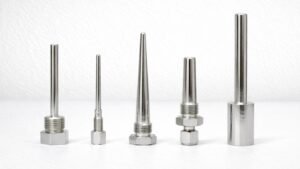
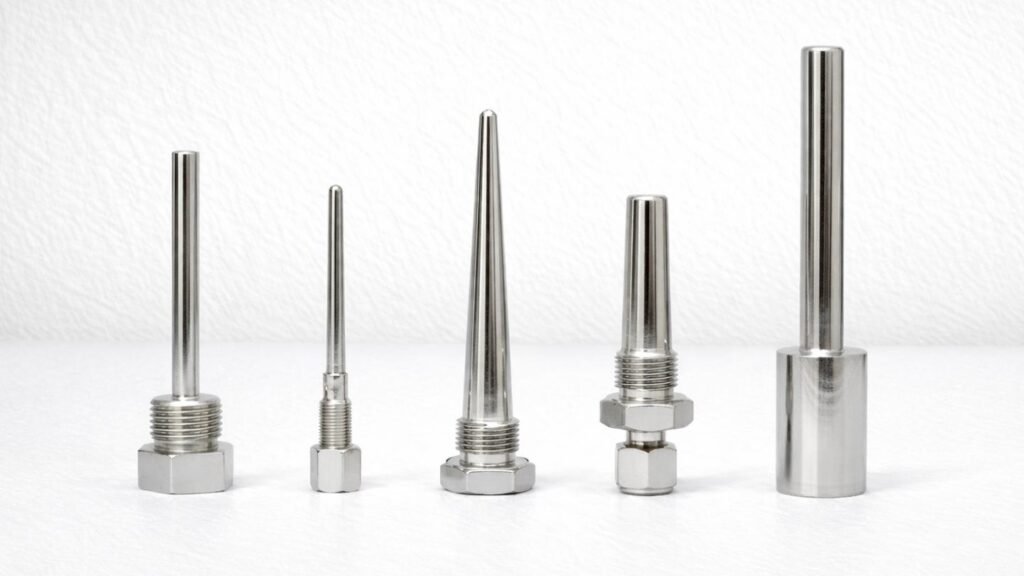
Threaded thermowells use a threaded connection and can be suitable for various industrial installations where this connection method is appropriate.
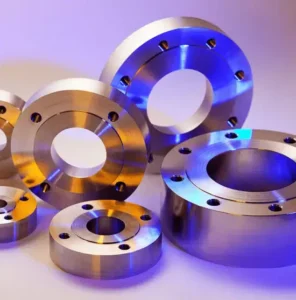
Flanged thermowells use a flange connection and are often considered for applications involving larger piping systems or demanding process conditions.
Welded thermowells are permanently attached to the process connection and can be used where a welded installation is required.
Socket-weld thermowells are another configuration used in suitable industrial piping applications.
The choice depends on the equipment, process conditions and installation requirements.
Thermowell Designs
Thermowells can also differ in their physical shape.
A straight thermowell maintains a relatively consistent diameter along its length.
A tapered thermowell gradually changes diameter and may offer a balance between strength and response characteristics.
A stepped thermowell incorporates changes in diameter along its length and can be selected for particular installation or measurement requirements.
Material Selection
Thermowell material should be compatible with the process environment.
Stainless steel is commonly considered for applications requiring corrosion resistance, while carbon steel and specialised alloys may be appropriate for other operating conditions.
The process medium, temperature, pressure and surrounding environment should all be evaluated before selecting the material.
How to Select the Right Thermowell
Choosing between different types of thermowells requires consideration of the actual process.
Important factors include:
- Operating temperature
- Process pressure
- Fluid characteristics
- Flow velocity
- Corrosion potential
- Installation connection
- Sensor dimensions
- Mechanical loading
The thermowell must also be compatible with the temperature sensor being used.
Where Are Thermowells Used?
Thermowells are used across industries such as chemical processing, oil and gas, petrochemical manufacturing, power generation, pharmaceutical production and water treatment.
Wherever industrial temperature measurement is required, the appropriate protective arrangement can contribute to reliable instrumentation.
Conclusion
Understanding the different types of thermowells helps engineers make more informed decisions when designing temperature measurement systems.
The correct thermowell should be selected based on process conditions, connection requirements, material compatibility, sensor dimensions and mechanical considerations. A technically appropriate design can provide effective sensor protection while supporting reliable temperature monitoring.