Heat exchangers transfer thermal energy between fluids without necessarily allowing them to mix. They are used throughout industrial facilities for heating, cooling, condensation and heat recovery.
Although a heat exchanger may appear to be a single piece of equipment, its performance depends on several interconnected components.
Heat exchanger tubes, tube sheets and baffles are particularly important in shell-and-tube designs. Understanding the function of each component can help engineers and maintenance teams make better decisions about equipment selection and servicing.
What Are Heat Exchanger Tubes?
Heat exchanger tubes provide the surface through which heat is transferred between two fluids.
Depending on the design, one fluid flows through the tubes while the other flows around the tubes within the shell.
The tube material and dimensions can significantly affect heat-transfer performance and service life.
Important considerations include:
- Tube material
- Outer diameter
- Wall thickness
- Tube length
- Thermal conductivity
- Corrosion resistance
- Operating temperature
- Operating pressure
Materials may include stainless steel, carbon steel, copper alloys, titanium and other specialised materials depending on the application.
What Is a Tube Sheet?
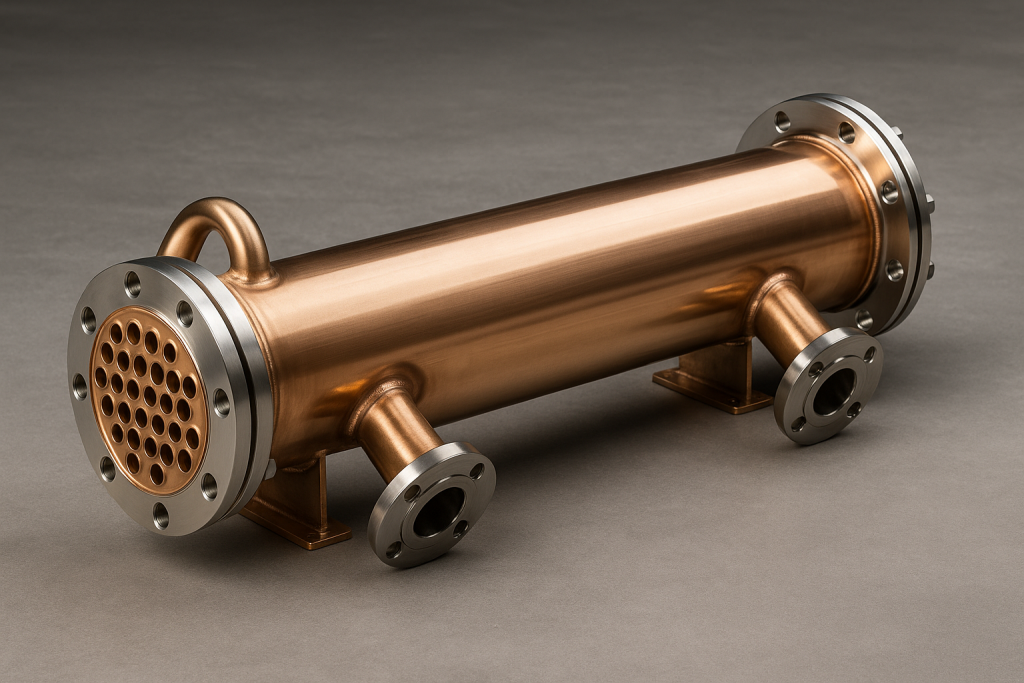
A tube sheet is a structural component that holds and positions the heat exchanger tubes.
In a shell-and-tube heat exchanger, tubes are typically secured within openings in the tube sheet. The tube sheet also contributes to separating the shell-side and tube-side fluids.
Because it is exposed to pressure and thermal loads, its material and thickness must be selected according to the equipment design.
What Are Baffles?
Baffles are internal components positioned within the shell of many shell-and-tube heat exchangers.
Their functions can include:
- Directing shell-side fluid flow
- Supporting tubes
- Increasing turbulence
- Improving heat transfer
- Reducing unsupported tube spans
By changing the path of the shell-side fluid, baffles can increase contact between the fluid and the tube surfaces.
However, baffle design must balance heat-transfer performance against pressure drop and other operating considerations.
How Do Tubes, Tube Sheets and Baffles Work Together?
These three components perform different but interconnected functions.
Tubes provide the heat-transfer surface.
Tube sheets hold and support the tubes while contributing to fluid separation.
Baffles direct shell-side flow and support the tube bundle.
Together, they help the heat exchanger transfer thermal energy while maintaining the structural integrity and intended flow arrangement of the equipment.
Why Tube Material Matters
The tubes are directly exposed to process fluids, making material compatibility particularly important.
A material that performs well in one application may not be suitable for another because of differences in:
- Corrosion
- Temperature
- Pressure
- Fluid chemistry
- Fouling
- Erosion
For example, stainless steel may be selected for certain corrosive environments, while other applications may require different alloys.
Why Tube Sheet Design Matters
Tube sheets need to withstand mechanical and thermal stresses while maintaining the required tube arrangement.
Factors such as tube diameter, tube pitch, material, pressure differential and equipment configuration influence tube sheet design.
Poorly selected or damaged tube sheets can affect leakage control, structural integrity and overall heat exchanger performance.
Why Baffle Design Matters
Baffle spacing and configuration influence shell-side flow.
If the design creates insufficient flow interaction, heat-transfer performance may be affected. Excessively restrictive configurations can increase pressure drop.
Therefore, baffle arrangement needs to be considered alongside the heat exchanger’s thermal and hydraulic requirements.
Common Problems With Heat Exchanger Components
Industrial heat exchangers may experience:
Tube Fouling
Deposits can accumulate on tube surfaces and reduce heat-transfer efficiency.
Tube Corrosion
Aggressive process fluids can damage tubes over time if material selection or operating conditions are unsuitable.
Tube Leakage
Damage or degradation can allow fluids to cross between circuits, depending on the failure location.
Baffle Damage
Mechanical vibration, erosion or operating conditions can affect baffles and tube support.
Tube Sheet Issues
Corrosion, cracking or problems around tube-to-tube-sheet connections can affect equipment integrity.
Selecting Industrial Heat Exchanger Components
When replacing or specifying components, engineers should consider:
- Heat exchanger design
- Existing component dimensions
- Material grade
- Operating pressure
- Operating temperature
- Process fluid
- Corrosion conditions
- Thermal requirements
- Applicable design standards
- Manufacturer documentation
Using components that match the original equipment specifications can be important for maintaining compatibility.
Maintenance and Replacement Considerations
Heat exchanger maintenance may include inspection, cleaning, tube testing and replacement of damaged components.
Before replacing tubes, tube sheets or baffles, maintenance teams should verify the original equipment specifications and assess the cause of failure.
Replacing a component without addressing the underlying operating issue may result in repeated problems.
Conclusion
Heat exchanger tubes, tube sheets and baffles each serve a distinct function within a shell-and-tube heat exchanger.
Tubes provide the primary heat-transfer surface, tube sheets support the tube bundle and help separate fluid circuits, while baffles direct shell-side flow and support the tubes.
Understanding these components makes it easier to evaluate maintenance requirements, replacement parts and equipment specifications when sourcing Industrial Heat Exchanger Components for demanding process applications.